
When people ask me what I do, I always reply that I am a publisher. This invariably leads to one of two questions - either “where is your printing press?” or “what do you publish?”
The first question is a commonly held misconception that a publisher is the same as a printer. Historically, a couple of centuries ago, that would be the case and, even today, there are publishers that operate their own presses but the great majority rely on specialist printers that have the facilities to produce anything from fine art prints to bound books. It is an area of the business that I would never consider. The investment is huge with the need for constant technology upgrades and printing requires a high level of skilled staff. Over 40 years, I have seen many printers close down because they cannot afford to keep up with the technology. It is a tough business often working on razor-thin margins.
The second question - what do I publish? - is the straight forward answer of book publishing but that wasn’t always the case. In 1982, I left Open Eye, the media project I had established in Liverpool, to open a commercial photography business with two other colleagues. The timing was dreadful but, after nine years, I had had enough of the constant battles running a grant-funded arts organisation. Liverpool was on its knees at the time, on the cusp of being abandoned by the Thatcher government considering a policy of managed decline of the city. (I had moved to the city in 1970 when the population was just over 600,000. By 1981 that had dropped to 502,000 and it still had further to fall). Major companies had either relocated or closed down and those that remained, including advertising and design agencies, had retrenched and were unwilling to try out a new company.
Facing this struggle to survive, I decided the answer was to move away from being a service business to a product-centred one. The acute economic problems of Merseyside were still there but I sensed having physical products to sell was infinitely more attractive than sitting waiting for the phone to ring from a prospective client. And so began my career in publishing - initially with a range of oversized postcards that expanded into posters and calendars aimed directly at the local market.
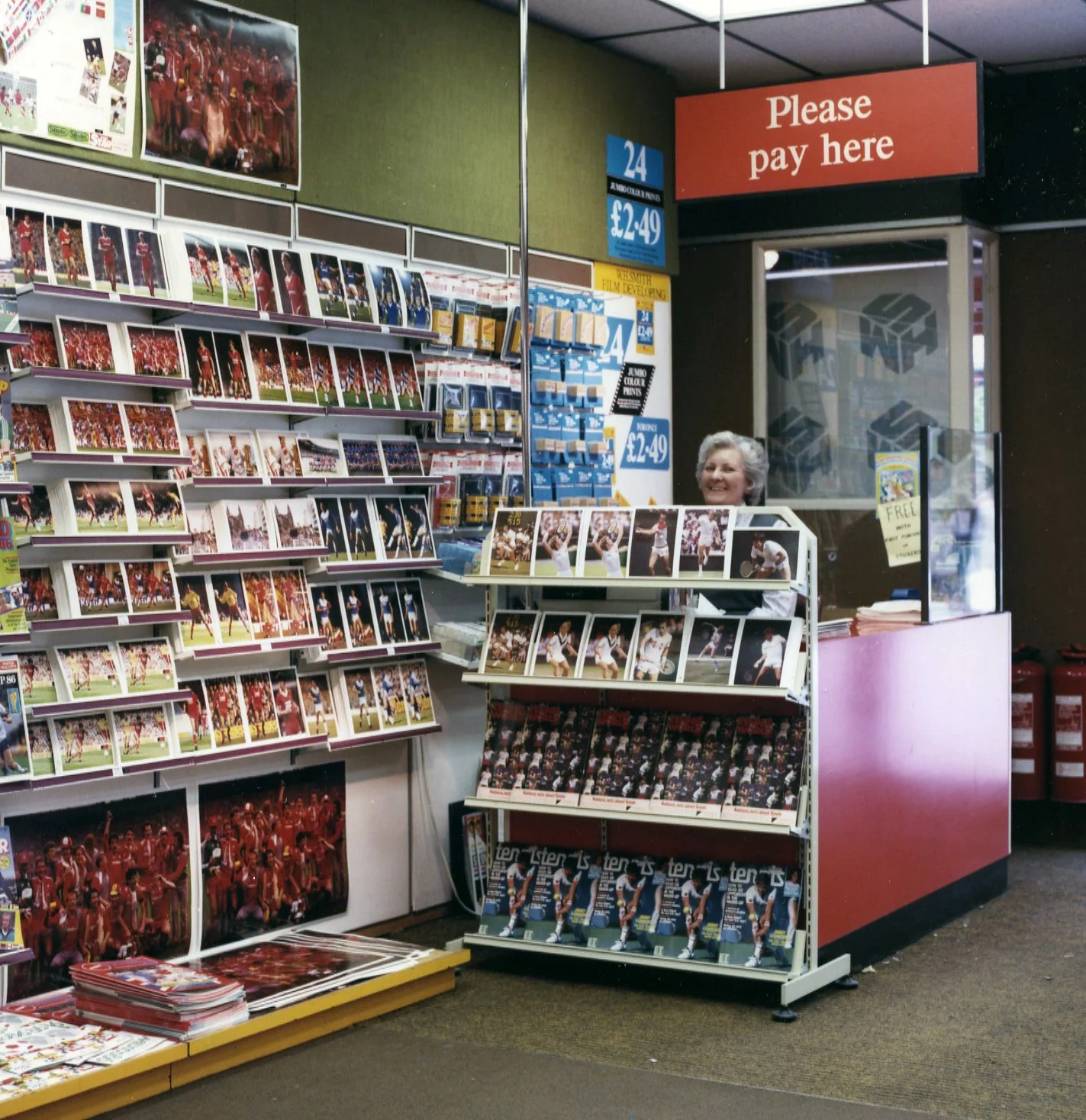
By 1985, I had expanded the range into football cards and posters - servicing both Liverpool, Everton and Manchester United football clubs at a time when players’ image rights simply didn’t exist. The photograph is of the front of WH Smith’s main branch in Liverpool (which was at the time the company’s most profitable in the country). All the football posters, postcards and tennis postcards were published by my company, Light Impressions. I would give a right arm for that level of product placement today.
Light Impressions was ultimately brought down by the failure of its photography business. Demand gradually seeped away unlike the ever-increasing overheads. Fortunately, the foray into publishing had shown a path forward. There was a local demand for the right project - it was just a matter of finding out what people wanted and were prepared to pay for. Football is fairly obvious but I discovered there was a good market for postcards and calendars of historical and contemporary views.
By concentrating on a local market, I built up a strong network of outlets - high street retailers like WH Smith, bookshops, tourist outlets and museum/gallery shops. I had grown in confidence in my understanding of publishing and was now ready to make my first move into book publishing.
In my previous posts, I discussed the difficulties facing the photobook market but, perhaps, my early experiences in publishing point to adopting a wider perspective. Concentrating solely on a niche book market worked well for me for the best part of 15 years but the warning signs of a drop off in demand have been clear over the last three years. Publishing, as I have shown, embraces a host of alternatives. Perhaps it is time to explore some of those options again.